
District Places 1.0% Earned Income Tax Levy on Nov 2026 Ballot
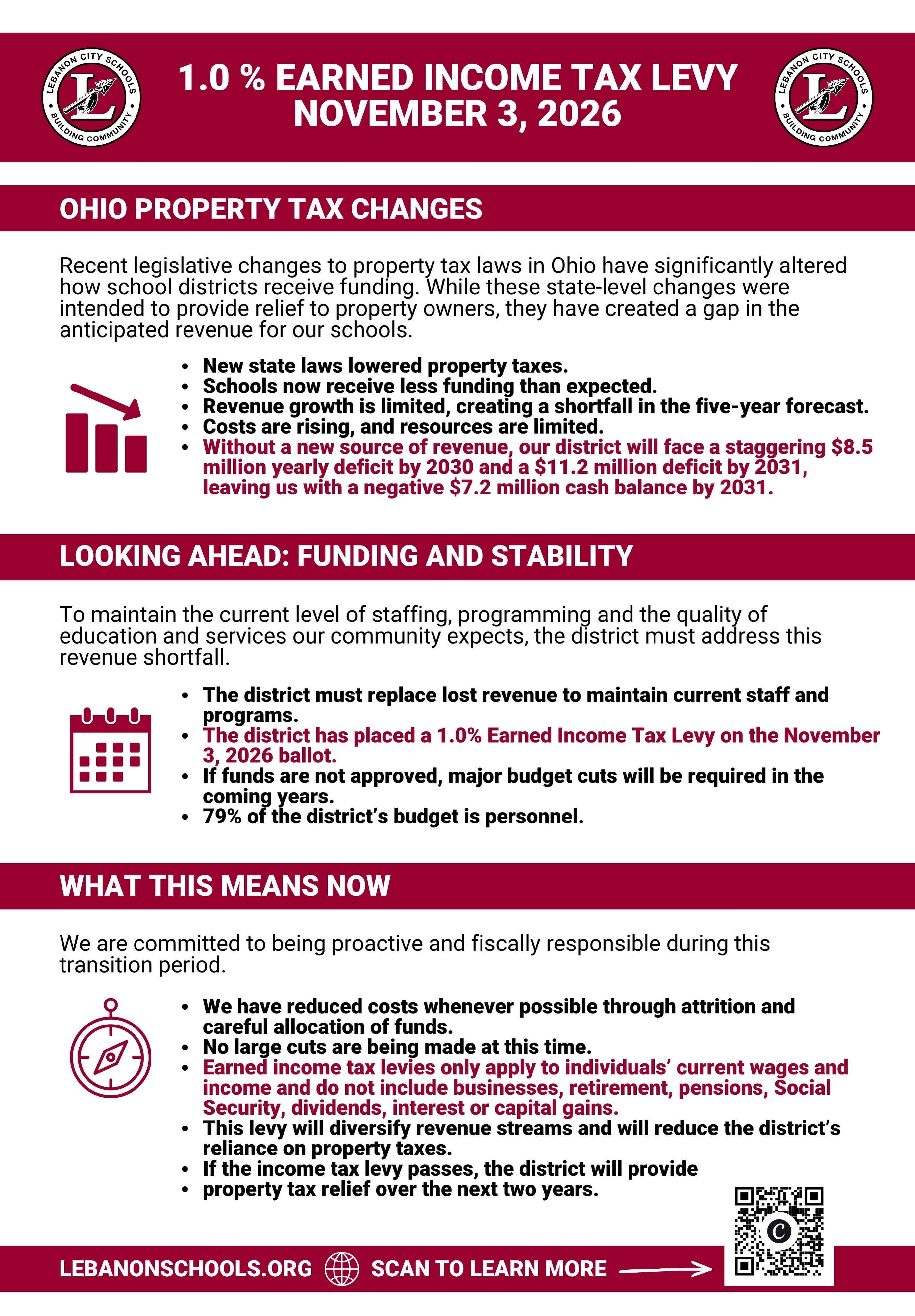
The Lebanon City School District Board of Education voted unanimously to place a 10-year, 1.0% Earned Income Tax Levy on the November 3 ballot. If the levy passes, the Board of Education will roll back 2.15 mills of property taxes, which will provide property tax savings to homeowners.
The 1.0 % Earned Income Tax is for operating expenses and capital improvement projects. It is NOT a property tax. An Earned Income Tax is collected by employers (regardless of their location) from people who live in the Lebanon City School district through payroll taxes. Self-employed individuals pay the tax via quarterly estimates. Earned income includes wages, salaries, tips, and self employment such as sole proprietorships and partnerships. Excluded includes unearned income such as retirement pensions, 401Ks, Social Security, interest, dividends, capital gains, and unemployment benefits.
This levy will generate $13.5 million per year. Property tax relief will NOT be on the ballot; the Board of Education sent a resolution to the Warren County Auditor's office to roll back property taxes if the levy passes. In 2027 the District can pay off the bond issue that built Bowman Primary School and added renovations to Lebanon High School two and a half years early due to refinancing and fiscal responsibility. This will reduce property tax collection by 1.38 mills and will save the district $210,000 in future interest payments. In 2028 the district will stop collecting the 0.77 Permanent Improvement Levy and will not seek its renewal in 2028. These measures will result in 2.15 mills of property tax reduction in the next two years.
"The Board considered all forms of revenue, but ultimately chose an Earned Income Tax because of the concern with rising property taxes. To generate the same amount of revenue, the District would need to place a 7.81 mill property tax levy on the ballot,' said Isaac Seevers, Superintendent.
State property tax reform has reduced the district's anticipated revenue by $13 million over the next four years, with no increased revenue from the state. With the passage of the property tax reform, the district no longer sees increases on its property tax levies. "Legislators have encouraged us to diversify our revenue to become less dependent on property taxes. Unlike fixed property taxes, an earned income tax is scalable. It grows naturally as wage-earning families move into active residential developments across our community. As new housing developments are built, the district sees an increase in revenue with an earned income tax levy," Seevers said.