Income Tax Levy Resources
District Places 1.0% Earned Income Tax Levy on November 3, 2026 Ballot
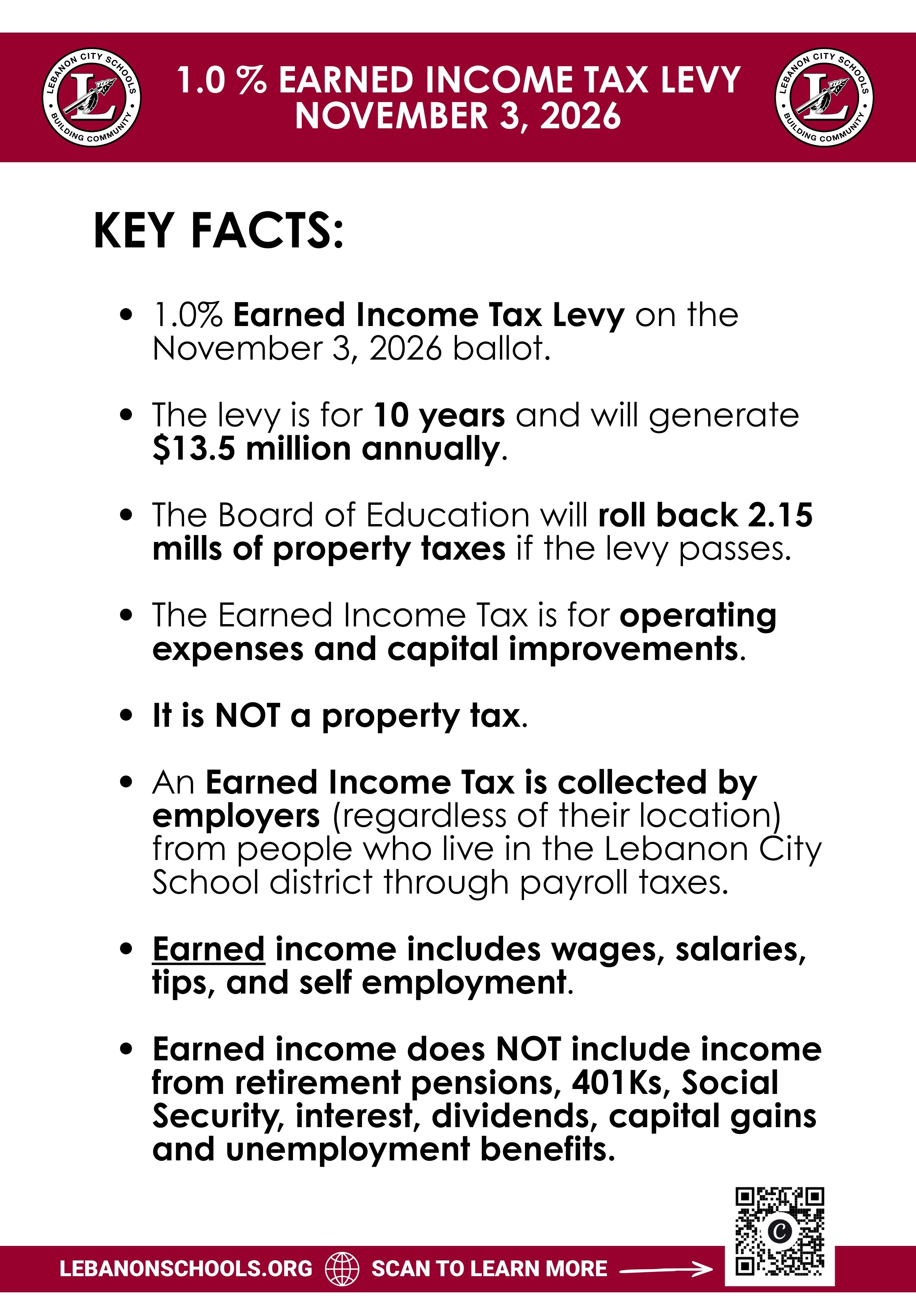
The Lebanon City School District Board of Education voted unanimously to place a 10-year, 1.0% Earned Income Tax Levy on the November 3 ballot. If the levy passes, the Board of Education will roll back 2.15 mills of property taxes, which will provide property tax savings to homeowners.
The 1.0 % Earned Income Tax is for operating expenses and capital improvement projects. It is NOT a property tax. An Earned Income Tax is collected by employers (regardless of their location) from people who live in the Lebanon City School district through payroll taxes. Self-employed individuals pay the tax via quarterly estimates. Earned income includes wages, salaries, tips, and self-employment such as sole proprietorships and partnerships. Excluded includes unearned income such as retirement pensions, 401Ks, Social Security, interest, dividends, capital gains, and unemployment benefits.
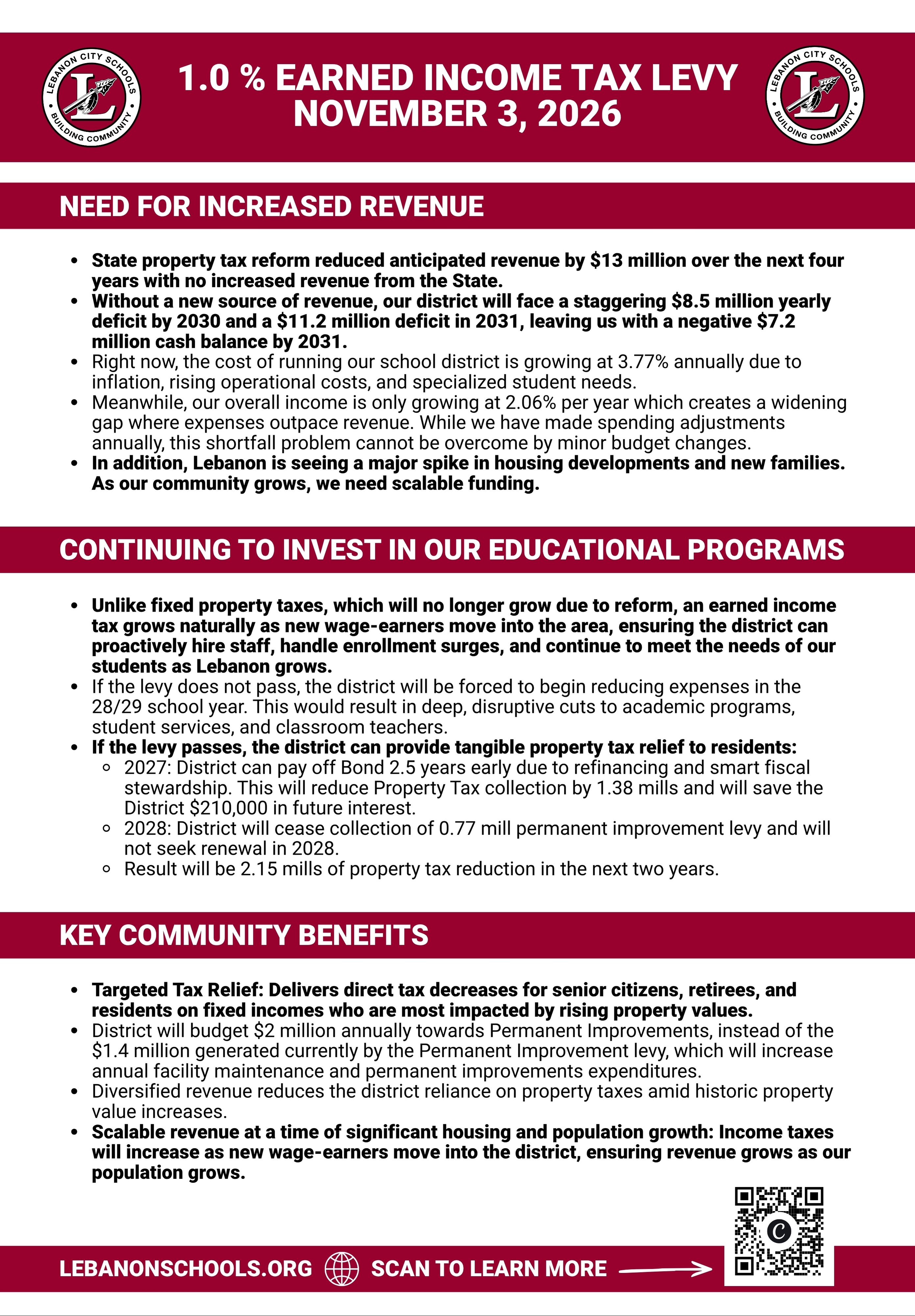
This levy will generate $13.5 million per year. Property tax relief will NOT be on the ballot; the Board of Education sent a resolution to the Warren County Auditor's office to roll back property taxes if the levy passes. In 2027 the District can pay off the bond issue that built Bowman Primary School and paid for renovations at Lebanon High School two and a half years early due to refinancing and fiscal responsibility. This will reduce property tax collection by 1.38 mills and will save the district $210,000 in future interest payments. In 2028 the district will stop collecting the 0.77 Permanent Improvement Levy and will not seek its renewal in 2028. These measures will result in 2.15 mills of property tax reduction in the next two years.
"The Board considered all forms of revenue, but ultimately chose an Earned Income Tax because of the concern with rising property taxes. To generate the same amount of revenue, the District would need to place a 7.81 mill property tax levy on the ballot," said Isaac Seevers, Superintendent.
State property tax reform has reduced the district's anticipated revenue by $13 million over the next four years, with no increased revenue from the state. With the passage of the property tax reform, the district no longer sees increases on its property tax levies. "Legislators have encouraged us to diversify our revenue to become less dependent on property taxes. Unlike fixed property taxes, an earned income tax is scalable. It grows naturally as wage-earning families move into active residential developments across our community. As new housing developments are built, the district sees an increase in revenue with an earned income tax levy," Seevers said.
Have a question?
Please email us: ContactLebanon@LebanonSchools.org.
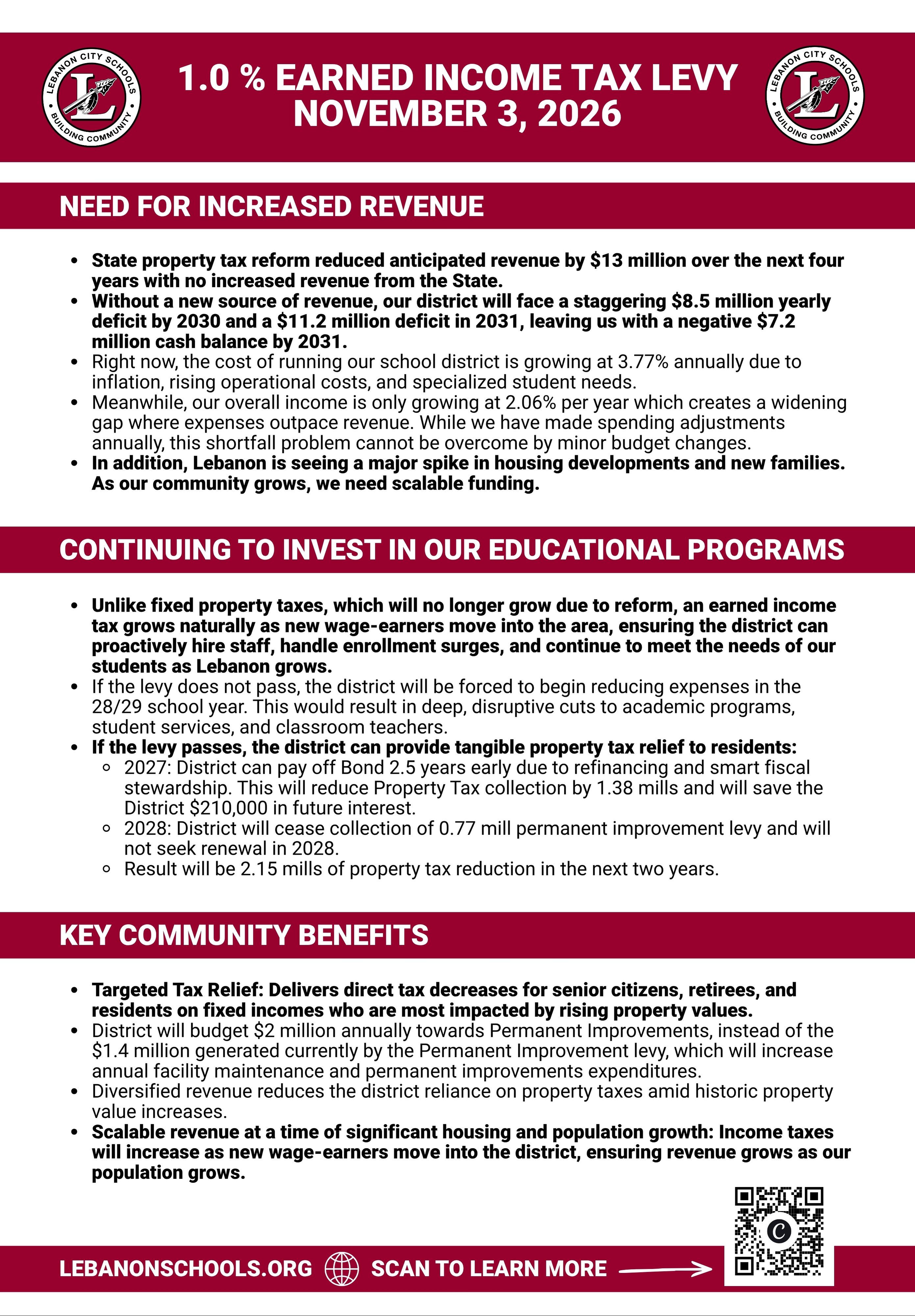
Download our Presentation
Community Education Forum
Watch the Community Education Forum held August 3 - Superintendent Isaac Seevers and Treasurer Karen Ervin presented about the Earned Income Tax.
A Conversation with Audior Matt Nolan
In this video, Superintendent Isaac Seevers and Treasurer Karen Ervin talk to Warren County Auditor Matt Nolan about Property Tax Reform and what is next for public entities.
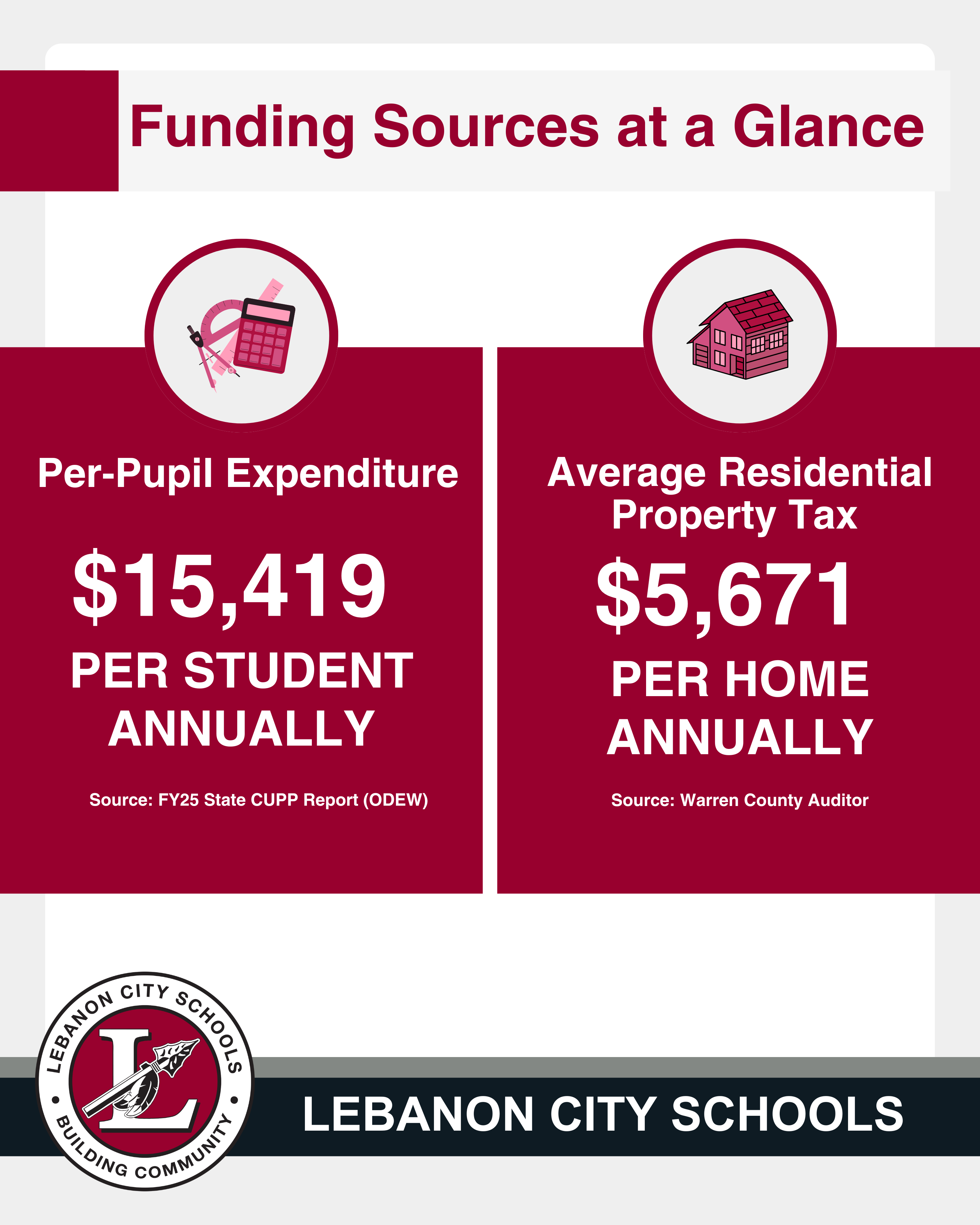
Per Pupil Expenditure
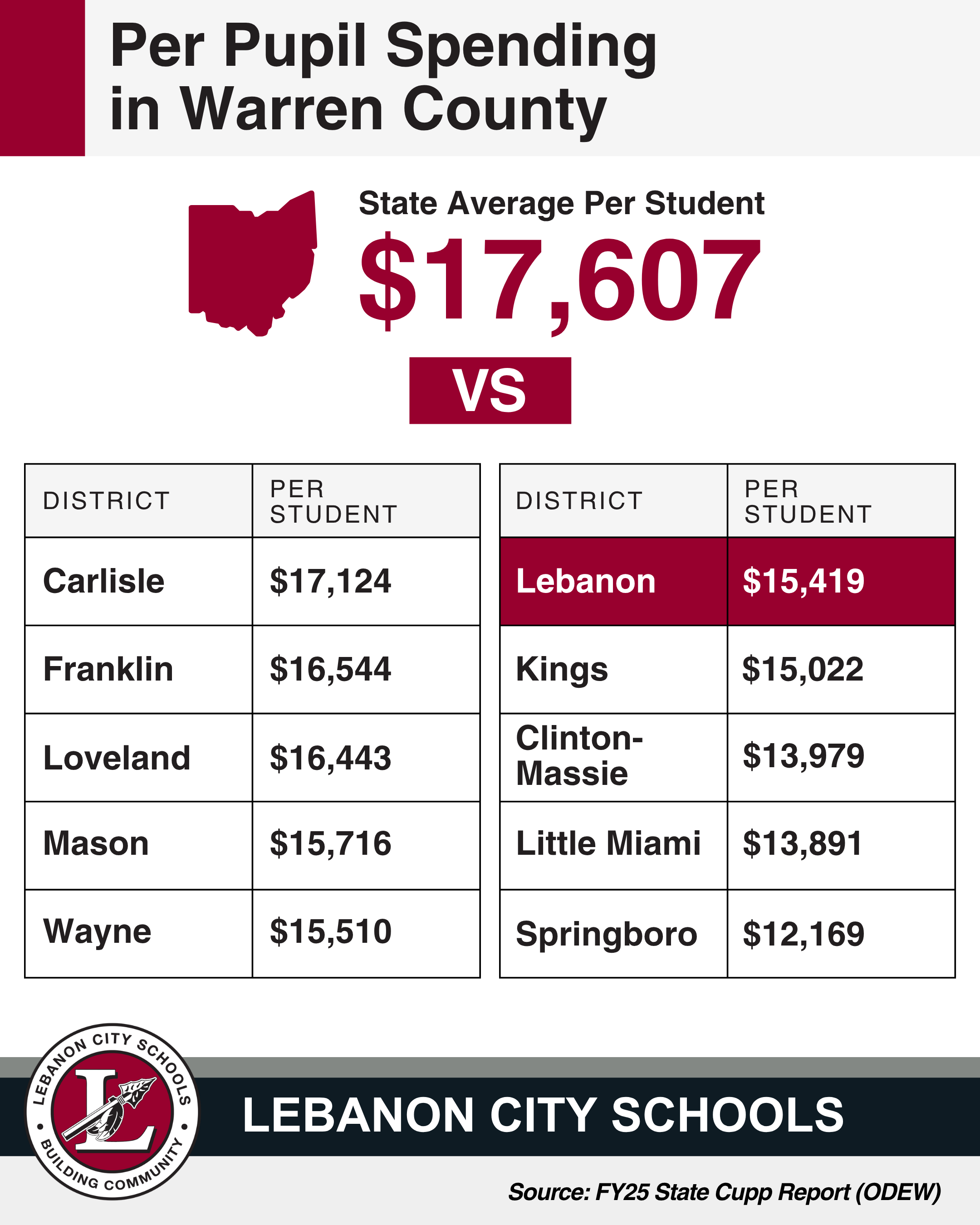
Per Pupil Spending in Warren County
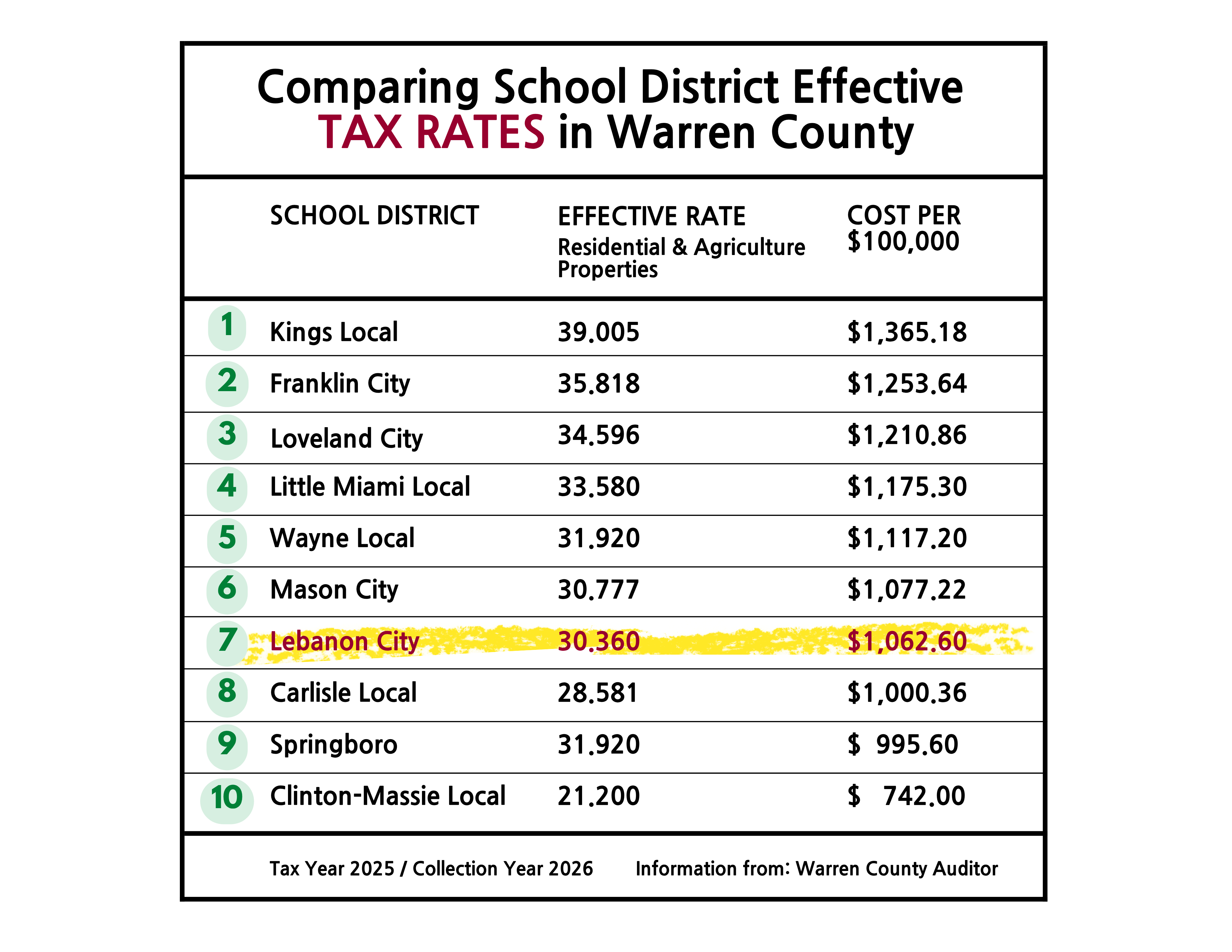
Tax Rate Comparisons in Warren County
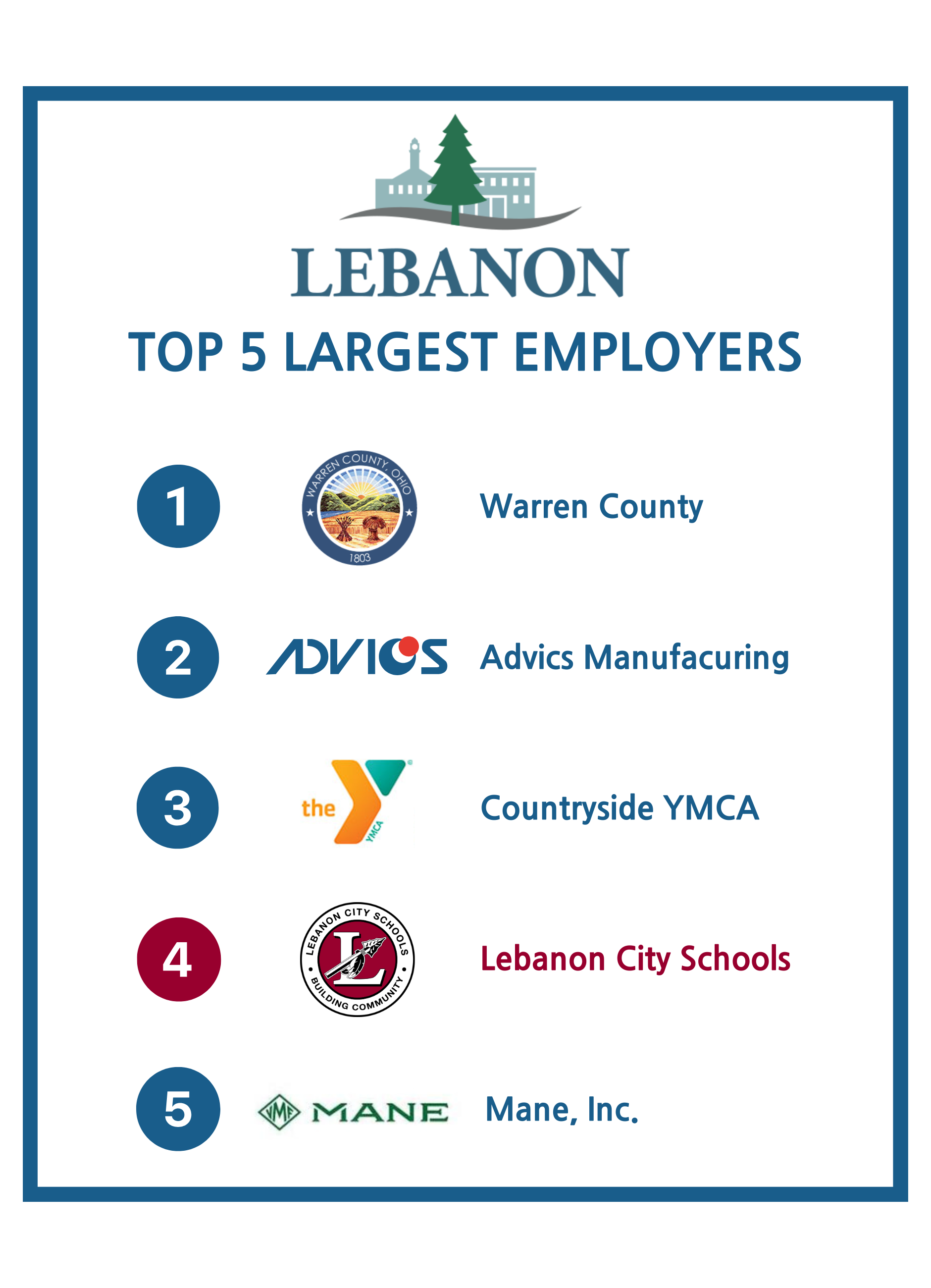
Top 5 Employers in Lebanon
Other Financial Resources:
Watch our Video: Your Investments In Learning
This is what your investment in Lebanon City Schools looks like. Students learning. Staff leading. Opportunities everywhere. The best part of our schools is the people inside them.
Frequently Asked Questions
We're working on building our FAQ for the Earned Income Tax Levy. If you have a question, please email us.
Click on the plus sign on the right hand side to see an answer:
What is on the ballot November 3, 2026?
Lebanon City Schools has placed a 1.0% Earned Income Tax Levy on the November 3, 2026 ballot.
Will this levy provide property tax relief?
Yes. Passing the levy delivers a total property tax roll back of 2.15 mills:
- Phase 1 (Jan. 2027): Early payoff of the bond issue that paid for additions to Lebanon High School and Bowman Primary School (2.5 years ahead of schedule), saving taxpayers more than $210,000 in interest and reducing taxes by 1.38 mills.
- Phase 2 (Jan. 2028): The district will stop collection on the Permanent Improvement (PI) levy, providing an additional 0.77 mills of relief.
What is the expected amount of property tax relief?
One mill of property tax equals $1 for every $1,000 of a property's appraised value. Ohio calculates taxable value at 35% of a property's appraised value. So, 1 mill generates $35 per $100,000 of appraised market value of a home.
For a home valued assessed at $420,000, the 2.15 mill reduction will equate to a savings of $277.66.
To see your home's value and the amount that will be reduced from your property tax bill, follow these steps:
- Search for your property on the Warren County Auditor's website.
- Once on the Property Summary Page, click on Tax Bill on the left side.
- Click the Distribution tab.
- You can view different taxes paid for the property. Under Schools, the 2.18 reduction will be for the 14001 and 20011 amounts.
How does the ballot language read?
A. The following language will be on the ballot:
05 PROPOSED INCOME TAX
Lebanon City School District
A majority affirmative vote is necessary for passage
Shall an annual income tax of 1 per cent on the earned income of individuals residing in the school district be imposed by Lebanon City School District, for 10 years, beginning January 1, 2027, for the purpose of current expenses?
FOR THE TAX
AGAINST THE TAX
Why isn't the property tax rollback in the ballot language?
A. Ohio law does not allow it. The Board of Education passed a resolution in July stating that, if the 1% earned income tax passes, the District will stop collecting 2.15 mills of existing property taxes: 1.38 mills for high school/primary school bond debt and 0.77 mills for permanent improvements. Ohio law only allows a property tax reduction to be included on a school district income tax ballot question when the existing property tax is for current operating expenses. The 2.15 mills the Board has committed to stop collecting are for bond debt and permanent improvements, not current operating expenses. Because the property taxes serve a different purpose, their reduction cannot be included as part of the income tax ballot language.
How can the board decide to reduce property taxes if the levy passes?
While the board cannot unilaterally add taxes, they have the legal right to "give back" or cease collection of existing taxes. The board passed a resolution in July stating that if the 1% earned income tax passes, they will stop collecting specific property taxes (1.38 mills for high school/primary school bonds and 0.77 mills for permanent improvements), resulting in a 2.15-mill reduction.
How did the Board decide upon the 1% number? Were other percentages considered?
A 0.75% rate was considered, but it would only last five years and would not allow the district to offer property tax relief. The 1% rate is intended to keep the district off the ballot for new money until at least 2032.
How do the district's finances stand?
What will this levy pay for?
This levy will be used for general operating expenses and capital expenses.
How much will this levy generate?
This levy will generate $13.5 million per year, equivalent to 7.81 mills of property tax. Due to how these taxes are collected at the state level, it will take 18 months for an earned income tax levy to get to full collection.
What will this levy cost me?
If you are a wage earner, at the 1% earned income tax rate it will cost $10 for every $1,000 of earned income. Only earned income (wages, salaries, tips, and self-employment income) is taxed with this levy. If you receive income from social security, pensions, retirement-account withdrawals, investments, or similar sources, you will not pay for this levy; your cost will be $0.
How long will the Earned Income Tax levy last?
This levy is for 10 years.
Do businesses located or operating within the School District have to pay the school district income tax?
No. Ohio law stipulates that a school district income tax is on the income of district residents, not on businesses operating within the district. Businesses as an entity are not subject to the school district income tax.
Ohio law defines the "taxpayer" of a school district income tax as an individual who lives within the school district and has taxable school district income. A company with a store, office, or facility in the Lebanon City School District would not pay the school district income tax because it is not an "individual." Additionally, an employee who works in the district but lives outside the district would not pay the district income tax.
As an important distinction, business income received by a resident of the District would be included in that individual's taxable income if the District were implementing the Traditional Income Tax (rather than the Earned tax). However, this would also tax other forms of income, like retirement and investments.
Ohio Revised Code references: R.C. 5748.01(E), (G), and (H); R.C. 5747.021.
Is the income tax only on residents, people who work in Lebanon, or both?
Ohio law stipulates that a school district income tax is on the income of district residents. Ohio law defines the "taxpayer" of a school district income tax as an individual who lives within the school district and has taxable school district income. An employee who works in the district but lives outside the district would not pay the district income tax.
I am on a fixed income, what will this levy cost me each month?
Because this is an earned income tax, it would not apply to income from Social Security, pensions, retirement-account withdrawals, investments, or similar sources. If all of your income comes from these sources, your cost would be $0 per month. The tax would apply only to wages, salaries, tips, and self-employment income. At a 1% rate, the cost would be $10 for every $1,000 of earned income.
Is a 401k considered income?
No. 401k distributions are considered retirement investment income, not earned income (which only applies to W-2 wages). An earned income tax applies only to income earned from working, such as wages, salaries, tips, and net income from self-employment. It does not apply to Social Security, pensions, retirement-account withdrawals, interest, dividends, or capital gains.
What is the difference between an "Earned" Income Tax Levy and a traditional income tax levy?
The main difference is which types of income are taxed. An earned income tax applies only to income earned from working, such as wages, salaries, tips, and net income from self-employment. It does not apply to Social Security, pensions, retirement-account withdrawals, interest, dividends, or capital gains. A traditional school district income tax applies to a broader range of income and is generally based on the taxpayer’s Ohio adjusted gross income. This can include wages and self-employment income, as well as certain retirement, investment, and other income. Because Lebanon City Schools is proposing an earned income tax, residents whose income comes entirely from Social Security, pensions, investments, or other non-earned sources would not pay the tax.
Why has the district chosen an Earned Income Tax Levy versus a Property Tax Levy?
The Board considered all forms of revenue, but ultimately chose an Earned Income Tax because of the concern with rising property taxes. To generate the same amount of revenue, the District would need to place a 7.81 mill property tax levy on the ballot. State property tax reform has reduced the district's anticipated revenue by $13 million over the next four years, with no increased revenue from the state. With the passage of the property tax reform, we will no longer see increases on our property tax levies, and legislators have encouraged us to diversify our revenue to become less dependent on property taxes. Unlike fixed property taxes, an earned income tax is scalable; it grows naturally as wage-earning families move into active residential developments across our community. As new housing developments are built, the district sees an increase in revenue with an earned income tax levy.
Why has the district placed an Earned Income Tax on the ballot now?
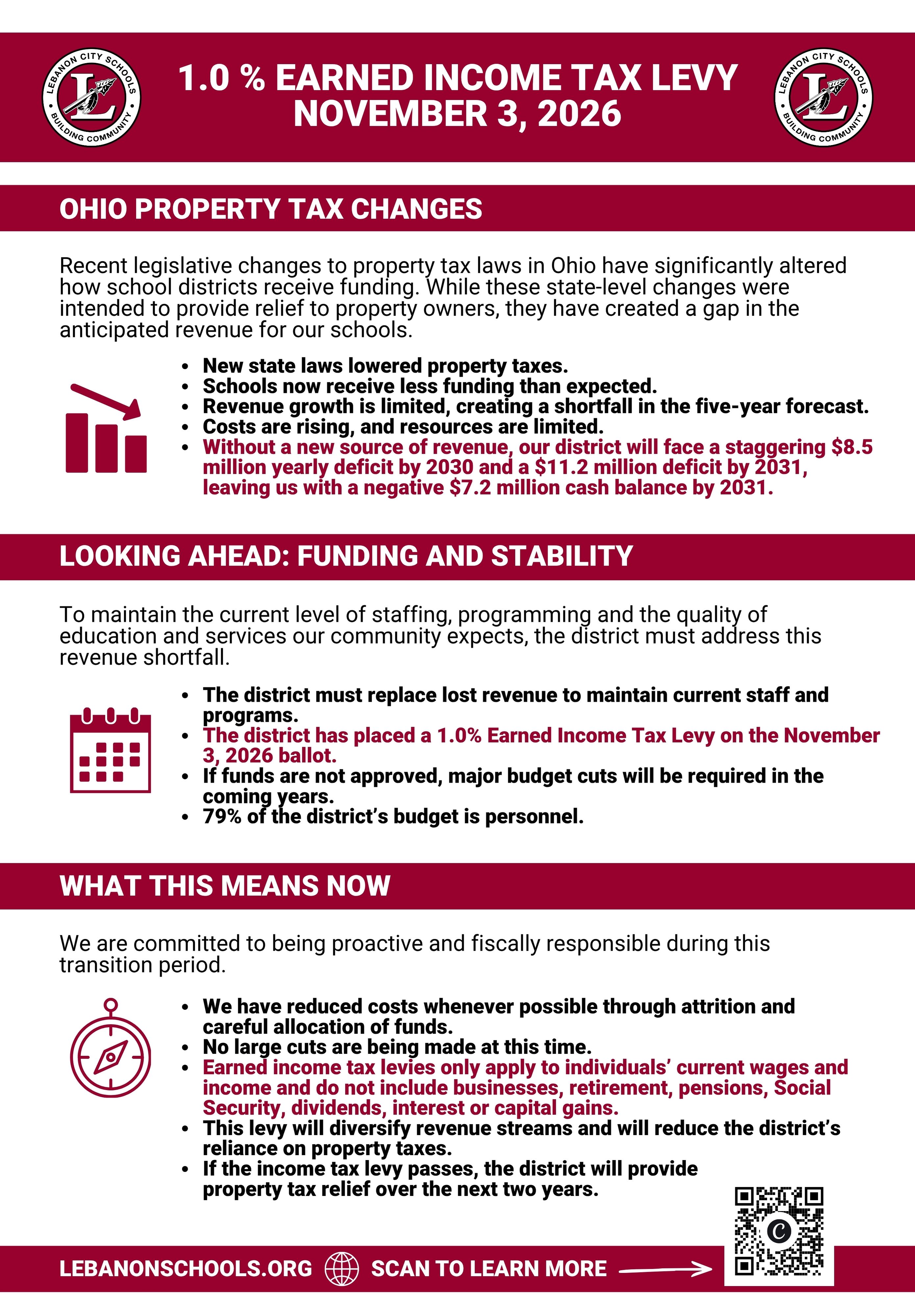
Without a new source of revenue, our district will face a staggering $8.5 million yearly deficit by 2030. The district's cash balance policy requires 90 days of cash on hand, which happens in FY28. Without this levy, our available operating cash will drop to a dangerous 16 days of funding in 2030, threatening our operational stability. The negative balance in 2031 requires the Treasurer to present a plan to the State of Ohio.
Has the district tried cutting costs before asking for more money?
Yes. Over the past two years, the district has proactively implemented targeted cost-savings measures, saving more than $2.42 million through operational efficiencies, strategic staffing adjustments, and competitive grant funding.
Key savings and non-tax revenues include:
- Staffing Restructuring ($800,000 since 2024): Realized through natural attrition, retirements, resignations, and strategic position repurposing, all while preserving classroom instruction and high-needs student support.
- Grant Funding (more than $900,000): Secured outside grants for capital and safety projects to avoid using local taxpayer dollars. Funded improvements include water filling stations, floor cleaning machines, weight room flooring at Lebanon High School, safety door film, stop-arm cameras on buses, and bus technology upgrades.
- Transportation Efficiency Project (approximately $280,000 since 2024): Following a Transportation Efficiency Study, shifting school start times by 15 minutes allowed us to streamline operations. We have been able to implement cost avoidance measures, such as fewer routes with fewer drivers, reducing reliance on private transportation, and reducing future fleet replacements (approx. $100,000/bus). This has allowed us to achieve more than $100,000 of annual savings and receive annual efficiency bonuses from the Ohio Department of Education totaling $80,000 since 2024.
- Fleet Management ($440,057 over 3 years): Reduced ongoing fuel and maintenance costs by replacing aging buses with newer, more efficient models.
How will this Earned Income Tax be collected?
Taxpayers will pay for this earned income tax through employer withholding, quarterly estimated payments, and annual returns. Employers are required to withhold the tax and submit payments to the state. The Ohio Department of Taxation administers and collects this local tax based on where you live, not where you work. Taxpayers will be required to file Ohio Form SD100 each year to report their earned wages and net self-employment earnings, even if they owe zero tax.
How does an Earned Income Tax Levy benefit the community?
The Earned Income Tax Levy secures stability through 2033, prevents major cuts to academics and special education, lowers the tax burden on seniors and retirees via 2.18 mills of property tax relief, upgrades facility maintenance power, and diversifies district revenue as our community grows.
Is the earned income levy the standard "tool of choice" for districts facing these shortfalls?
Yes. The Warren County Auditor and state officials have recommended diversifying revenue to reduce reliance on property taxes. Nearby districts like Carlisle and Kings have already moved toward this model. Click here to see other districts across the state who have adopted a similar model.
How will new housing builds affect the school district and this levy?
New wage earners moving into new homes would be subject to the new earned income tax.
Is there enough room for incoming students, and will the district need to build new facilities soon?
The district currently has capacity and has educated more students in the past than are currently enrolled. While we are currently using all available classrooms, we have the ability to accommodate some growth before we would need to add on. Buildings like Bowman, Donovan, Junior High, and High School were specifically designed to be expanded if needed. Building a new school is a multi-year process, and the district is currently assessing long-term needs to proactively plan for potential future needs.
Without the Permanent Improvement Levy, how will the district maintain buildings and grounds?
The 1% earned income tax generates sufficient revenue to set aside more money than we currently receive from the Permanent Improvement (PI) levy without having to go back to taxpayers for a renewal or increase to the current PI levy. Currently the PI levy generates $1.4 million. The 1% earned income tax allows us to set aside $2.0 million for Permanent Improvements. In the first few years of collection the District will allocate part of the collections to a Capital Projects fund to be used for future facility needs to modify existing spaces to meet the current needs of students.
What happens if the levy does not pass?
If the levy fails, the district will face an $8.5 million annual shortfall. To balance the budget, the district would be forced to make severe, disruptive cuts to academic programs, student services, and staffing levels. Staffing is 80 percent of the district's budget. The only way to achieve significant savings would be to reduce staffing. To save $8.5 million, approximately 100 staff members would need to be cut. Additionally, by 2030, the district's cash reserves would drop to just 16 days of operation, far below the recommended 90-day safety threshold the board has established for cash balance on hand.
When was the last time the district asked for new money?
The District requested new money through an emergency property tax levy during November 2019, which voters approved.
How is a School Earned Income Tax different from a City Earned Income Tax?
The school district income tax and the municipal income tax differ in many ways: municipalities collect the tax from both residents and non-residents working in the municipality, but the school district income tax is only on residents. Municipal taxes are levied on businesses whereas the school district income tax is on individuals only. The tax base for municipalities is generally wages, salaries, other compensation, or net profits of a business, but the school district income tax can be on either all sources of adjusted gross income (i.e., Ohio modified adjusted gross income less exemptions) or just on earned income.
Can you provide a recap of what happened with the substitute levy and how collections are going in that compared to what was passed?
Voters originally approved three separate emergency property tax levies: 2005, 2011, and 2019. In November 2022, voters approved combining these three separate levies into a single Substitute Levy that would continue to raise $12.2 million from the original taxpayers. However, a substitute levy also collects additional property taxes from any new homes that are built in the area. For the upcoming tax year, we anticipate collecting approximately $13.3 million as a result.
What happens when the substitute levy needs to be renewed?
Due to recent state property tax reform, substitute levies will be phased out and replaced by "fixed sum levies." Lebanon's substitute levy will continue to grow with new builds until it expires at the end of 2032. At that point, it will be renewed as a fixed sum that no longer grows with new construction.
If this passes, how many years would the district expect to go without the need for additional new funding?
Unless there are further changes to property tax laws or state funding, the district does not expect to ask voters for additional funding within the next eight years, until at least 2034.
Who runs and collects the income tax, and what is the administrative cost?
Taxpayers will pay for this earned income tax through employer withholding, quarterly estimated payments, and annual returns. Employers are required to withhold the tax and submit payments to the state. The Ohio Department of Taxation administers and collects this local tax based on where you live, not where you work. Taxpayers will be required to file Ohio Form SD100 each year to report their earned wages and net self-employment earnings, even if they owe zero tax. There is a 1.5% fee retained for state administrative purposes; however, this fee is already accounted for when the state completes the district's Estimated Income Tax Yield and Equivalent Millage report.
When is revenue from the income tax received by the school district?
The new tax becomes effective on January 1. The first payment will be received by the school district in April of that year (school districts can count on that payment being relatively small). Districts will receive four payments per calendar year, one each in January, April, July, and October. Each payment will be for the amount collected during the prior quarter. It will take approximately 1.5 years (six quarters) for districts to receive the full amount of taxes liable from the first year it is levied because of how the tax is collected. Employer withholding comes in throughout the year, but individual annual returns are not due until the following calendar year.
Why are special education costs increasing at Lebanon City Schools?
Special education costs are rising due to a steady increase in the number of students requiring specialized services, along with the growing complexity of those educational and support needs.
Key factors driving these cost increases include:
- Enrollment Growth: Over a four-year period, the number of students with disabilities (ages 5–21) grew by 161 students, a 23.7% increase. Today, students with disabilities represent approximately 17% of the district's total enrollment.
- High Per-Capita Costs: Educating a student with disabilities requires an average cost per capita of $18,283.10. In fiscal year 2025, special education expenses totaled over $14.7 million.
- Specialized Out-of-District Placements: Projected costs for 49 students requiring specialized educational programs total $3.46 million for the 2026–2027 fiscal year, with individual programs costing as much as $90,000 per student.
- Required Support Staffing: To maintain compliance and provide quality inclusive care, the district has had to hire additional certified staff, including intervention specialists, instructional aides, and behavior support personnel.
What school districts in Ohio levy an income tax now?
You can view a list of school districts with a school district income tax by clicking here. Click here to see an interactive map.
How do you plan to get the word out to the community?
District officials can only provide factual information. They plan to send mailers, conduct "coffee chats" and presentations to local groups, and will maintain a Frequently Asked Questions page on the district website.
I'd like more information about the levy campaign. Who do I contact?
Contact Roy MacCutcheon for information about the levy campaign: (513) 836-0055.
Have a question?
Please email us: ContactLebanon@LebanonSchools.org.